
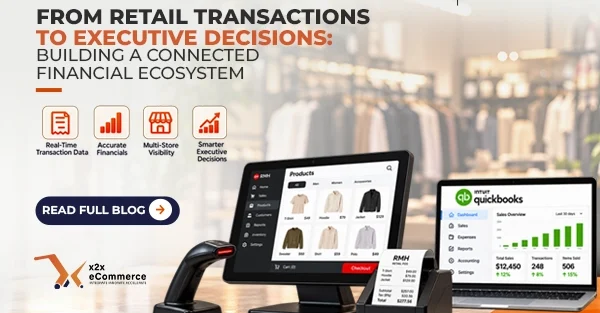
Every time a customer comes up to your register and makes a purchase, you have a story of data starting. Frontline solution Retail Management Hero (RMH) captures the first part perfectly: what product was sold, what time of day it was done, how it was paid, and the amount of tax collected. For a retailer’s executive, however, one particular transaction means nothing; it’s the aggregation of thousands of these small stories that becomes the real power. The link between a transaction and a strategic decision of the C-suite is a coherent financial ecosystem that requires careful integration.
The Reality of a Siloed Retail System
Too often, the transformation from transaction to executive decision simply stops at the very first step. RMH is great at being a Point-of-Sale solution, and QuickBooks is great at being an accounting solution. However, in absence of integration, there is a dead zone between the two.
RMH to QuickBooks integration has been largely achieved through manual data export and spreadsheets manipulation before uploading them in bulk. During this process, valuable context goes missing. The revenues from a particular day usually land up in a single, anonymous revenue line item. Consequently, any information about which departments are flourishing, what effect various tender modes are having on the flow of cash, and how complex the taxes are becoming becomes inaccessible. It results in accurate accounting books but leaves management in the dark.
Connecting the Dots Through x2x
To build a financial ecosystem, it is essential to remove the dead zone altogether. Here is where x2x RMH to QuickBooks integration comes to the rescue. Unlike most other methods, x2x does not merely facilitate data transfer from one point to another.
RMH uses the terminology of retail baskets, SKUs, and tenders. QuickBooks uses the terminology of accountancy charts of accounts, classes, and journal entries. The x2x integration serves as the real-time translator. It automatically translates RMH departments into QuickBooks revenue and Cost of Goods Sold (COGS) accounts. It makes sure that tax liabilities are correctly divided per jurisdiction and that daily payment batches are translated into bank deposits without any human keystrokes.
Executive Strategy
With such an ecosystem operating at its best, the change in executive capacity is immense. Since the information is connected and correctly sorted from the very beginning of the sale. As a result executives are enabled to go beyond the question of what happened and start wondering why it happened.
There’s no need for an executive to wait several days for a data analyst to parse through a spreadsheet if there’s a downturn in total margins. It’s possible to immediately drill down into QuickBooks and find out that even though top-line apparel sales may be on the rise, the actual margin is declining because of an increased use of discounted tenders or a tax variance, an illustration of the precise value provided by the x2x mapping. The ecosystem for multi-store owners will integrate all the data in all stores into QuickBooks.
Conclusion
In today’s retail environment, you cannot beat your competition if you rely on yesterday’s data when making strategic decisions as an executive. A financial ecosystem that is enabled by the x2x Retail Management Hero (RMH) for QuickBooks Integration makes sure that the blood of your business will reach the brain of your business. Don’t treat POS systems and accounting programs as separate entities. Bring them together and make the information flow seamlessly to the executives.