One Shopify store is already a challenge, but managing more than a few across regions, product lines, or brands feels like juggling flaming torches. For every store, you have a set of data, customers, inventory, and workflow. Without tools to help you, you will be stuck with scattered reports, non-uniform…
In today’s fast-moving landscape of digital commerce, having an online store is not good enough; it is all about how that store seamlessly connects with your back-end systems. The major pain point for companies using Shopify is that sales, inventory, and financial data are segmented across disconnected platforms. And that’s…
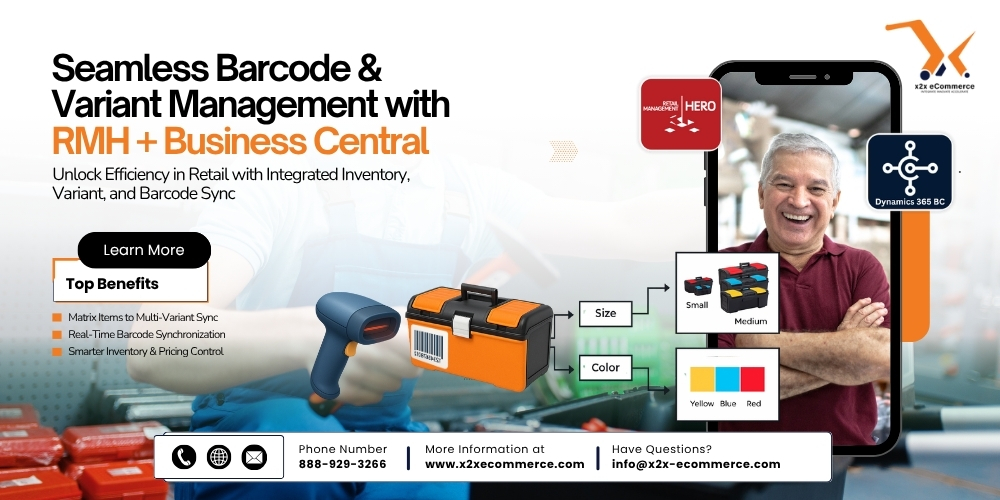
In today’s hectic retail culture, accurate inventory management and streamlined sales processes are crucial. With Microsoft Dynamics 365 Business Central integrated with Retail Management Hero (RMH), item variant and barcode management become not only crucial, but also productive. This blog explores how businesses can effectively manage item variants and barcodes…
In today’s rapidly moving digital economy, the lines between B2B and B2C distribution are blurring. Distributors no longer operate in silos, serving just retail or wholesale channels now, they must deliver seamless, integrated experiences on all sales channels. That is where omnichannel commerce comes into play as an epochal strategy,…
In the fast-retailing age of today, there is a need to utilize a Point of Sale (POS) system along with other business applications for frictionless operation and higher customer satisfaction. Selecting the most apt solution is taxing, and business houses do make errors that lead to inefficiency, added cost, and…
ERP integration is one of the most important components when preparing your business for holiday sales. With the help of ERP solutions, disparate business functions are integrated into a single efficient system, making your operations agile, effective, and customer-centric during this busy season. Here is how ERP integration can help…
Data centralization is the key to making smarter decisions. ERP integration gathers all scattered data from different departmentsāsuch as finance, inventory, and HRāinto one system. This information allows managers to gain real-time insights, identify trends, and make better-informed decisions faster. Time-Saving and Error Reduction ERP integration reduces the need to…
Introduction Order management is the core of any company. A good ERP system that integrates well will most undoubtedly make a difference. A well-integrated ERP system centralizes data, automates workflow processes, and hence enhances the speed and accuracy of processing orders, tracking inventory, customer service, and much more. Here’s what…
As businesses grow, their operations tend to become increasingly complex. To handle this complexity efficiently, Enterprise Resource Planning (ERP) integration with other systems becomes a critical solution. Hereās why ERP integration is essential for growing businesses: 1. Centralized Data Management ERP integration helps centralize data from various platforms, such as…
Enterprise Resource Planning (ERP) frameworks assume a basic part in giving the information expected to convey those client encounters. Generally utilized as administrative center frameworks taking care of bookkeeping and monetary data, ERP frameworks should now associate with a client confronting frameworks like Client Relationship The board (CRM), web-based business,…