
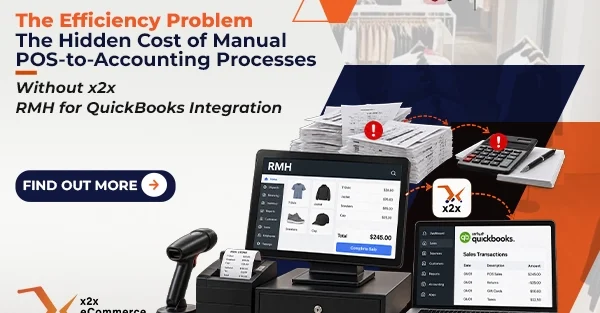
While retail executives might be consumed by front-end issues such as checkout efficiency, store layout, and fast delivery, the quiet enemy of profit lies within: Manual entry of POS transactions into accounting software. The use of RMH for generating revenues from the front end. While requiring your back-office staff to manually enter these transactions into QuickBooks means you are not saving costs with software but are rather paying a hidden tax with interest.
The False Hope of “Saving Money” with Workaround Manually
It’s common for most retailers to believe that since their POS system tracks daily sales. Everything else can be taken care of with the use of spreadsheets, exporting CSV files, and manual data entry. The “we’ve always done it this way” approach will lead you into a trap.
Manual data entry is an inefficiency bottleneck which takes a toll on resources, compromises the accuracy of the data, and causes mayhem at month-end. Your business is inefficiently losing its efficiency since RMH and QuickBooks are not seamlessly integrated with each other.
Costs of Not Integrating
There are not only consequences to using manual systems and lacking an automation process, but there are real, quantifiable costs to it. Below are some of the hidden costs comes with the manual integration of POS and accounting:
Time Spent Entering Data Manually
Consider all the time spent by your financial employees on downloading daily sales reports, separating tenders (cash, credit, gift cards), and entering them into QuickBooks. Do that math every month for a year. You can see how much time is wasted on administrative activities instead of financial planning and analysis.
The “Error Tax”
Humans make mistakes; software doesn’t. The wrong number entered a sales journal each day, the wrong tax number, or the wrong discount applied takes hours to figure out and correct. All these manual errors create inaccurate financial reports, improperly filed taxes, and reconciliation headaches that cost a fortune for external accountants to straighten out.
Invisible Inventory and Revenue Losses
When the accounting process is not done in real time. Then, all your inventory changes, returns, and discounts made in RMH do not update right away in QuickBooks. This creates discrepancies between your true inventory counts and your financial records, so that shrinkage is invisible, and you buy the wrong stuff at the wrong times, costing you money and leaving cash on the table.
End of the Month Madness
In the absence of any automated integration, the end of the month turns into a fire drill. The store manager and the accountant are left struggling for days to get their hands on the missing receipts and close their books. When finally, they get the finances report, the market moves on already. You are running your business in the rear-view mirror instead of the windshield.
The Solution: Data Stream Automation
This is when the x2x RMH for QuickBooks Integration becomes the must have tool rather than nice to have tool. x2x automates the entire data flow process.
The adoption of x2x brings back efficiency immediately. Everything, the sales, the returns, the layaways, and the adjustments are seamlessly pushed to their proper accounts in QuickBooks (Online and Desktop), without requiring any human involvement.
Your accounting department goes from being bookkeepers to consultants. Your month-end close goes from taking days to only a few hours, with precision and accuracy. Most importantly, your management can see the financial results of the business instantly.
Conclusion
The issue of inefficiency is not only one of wasting time but also that of underdevelopment. The POS-to-accounting process grows linearly meaning that as you add more outlets or increase the transactional volume, your back-office efforts grow linearly.
Implementation of the x2x RMH for QuickBooks Integration helps break the vicious cycle and automate your financial system. As a result, your people can concentrate on generating money rather than counting it.