
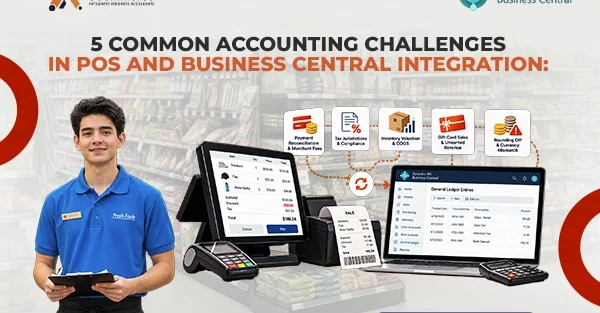
Point of Sale (POS integration) with Microsoft Dynamics 365 Business Central (BC) is supposed to give retailers one single version of truth. However, the underlying world of accounting problems makes this integration much more challenging than it may seem at first glance. The slight difference in POS data can become a real nightmare for an accountant. Specially when it appears in the General Ledger (GL). Below are five accounting problems in POS to Business Central integration.
1. Payment Reconciliation and Merchant Fees
One of the most annoying day-to-day processes for an accountant is reconciliation of the payment transactions from the point-of-sale with the bank deposits. As POS sends $100 transaction for a credit card sale, this transaction usually lands on a clearing account. But what gets deposited can be $97.50, considering merchant processing fees. In case of not having these fees included in your integration process, the clearing accounts will always have balance differences. Additionally, the batch settlements will include all weekend sales into one deposit on Monday, while BC does it daily.
2. Complexity of Tax Jurisdictions and Compliance
Taxation is not easy. While a POS system can be set up to support state, county, and city taxes, you will experience compliance challenges if they do not fit well into BC’s Tax Setup. The problems that frequently crop up include tax exemptions on certain items like food, differential rates on alcoholic beverages and clothing. Also, the destination-based sales tax on web-based orders. In case the POS calculates the tax using the location of the store, and BC uses that of the customer, then the GL will not match. There must be only one source of authority regarding taxation, either through POS or BC.
3. Inventory Valuation & Cost of Goods Sold Inconsistencies
Linking information about sales is only part of the problem; accounting for how this effect inventory is often where the integration process falls through. Timing is important when dealing with the cost of goods sold in Business Central. If the POS system enables the sale of something while there is no inventory of it (negative inventory) in Business Central, then BC will temporarily attribute zero or estimated costs to that product. After receiving the product and invoicing, BC calculates the cost and adjusts the general ledger accordingly. If the integration fails to perform these cost adjustments or the systems use different costing methods, then the result will be incorrect inventory valuation.
4. Managing Gift Card Sales and Unearned Revenue
From the point of view of accounting, sale of gift cards is not a sale but rather exchange of cash for liability. One of the most common integration problems here is that the POS system considers gift card sales as normal revenue. Thus overestimating sales in BC. To solve the problem, the correct mapping between gift card sales and a particular liability G/L account should be performed in BC. When the customer redeems the gift card, POS should notify BC about the transaction, and the money will be moved from the liability account to the revenue account.
5. Rounding Off and Currency Mismatch
There are cases where the fraction of cents in a retail business can create a lot of troubles. For example, in “Buy 2 Get 1 Free” or “3 for $10” promotions. POS system may calculate the price as $3.33 and create $0.01 difference between the actual sum and the required one. If there are differences in rounding between POS and Business Central, the posted transaction will not match and the posting will fail. Also, in countries where cash rounding is used, POS and BC need to have perfect match. The integration should include an algorithm that will help deal with the orphans by mapping it to “rounding G/L account.”
Conclusion
The process of POS integration into Business Central is not only about connection of two APIs but also involves profound knowledge of accounting and mapping. With proper consideration of payment fees, jurisdiction taxes, COGS, unearned revenue and rounding. You will be able to get the desired result from the integration.