
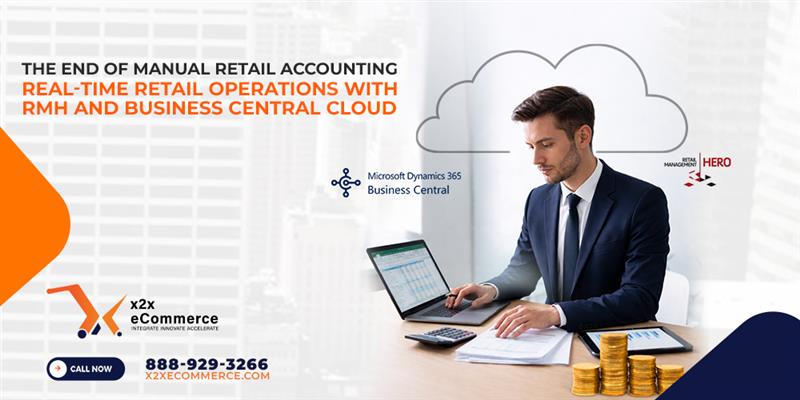
The back-office operations of a retail business have been akin to living in another world for many years. Whereas the front-end has been operating with the latest technology with electronic payments being used, the accounting operations were still relying on stacks of printed documents, spreadsheet calculations, and endless data entry. The gap that existed between the POS and the financial records could only be described as a black hole into which money and efforts would simply vanish.
This is changing. The end of manual retail accounting is coming thanks to the remarkable synergy of RMH and Microsoft Dynamics 365 Business Central running in the cloud.
The Old Way: A Formula for Error
With the conventional approach, the POS system (RMH) and the accounting software would be two systems that hardly communicated with each other while sharing the same office space. RMH did its job well in terms of recording transactions, handling taxation, and keeping track of inventory in the store. However, during “closing the books” on sales, things started to get interesting.
The accountants had to depend on end-of-day statements from the store, type them into their computers, and pray that they tally with what is in the cash register. This process, known as the “swivel chair” approach since it involves swivelling from one computer to another to key in data. It has proven time and again to be a recipe for disaster. Errors, such as transposing of digits and misclassification of accounts, are rampant because of fatigue.
The New Way: Perfect Integration
The process of integrating RMH with Business Central Cloud is a completely different approach. The two applications do not try to talk to each other; rather, they operate like one coherent entity.
RMH continues to specialize in what it does best being the expert on the “edge” and taking care of the intensive processes involved in retail sales. At the same time, Business Central Cloud acts as the brain operating in the cloud environment. Also making decisions about the bigger financial picture.
Transaction Entry to Accounting Ledger in Real-Time
Think about what the automation of this workflow means. Not only will the cashier at RMH enter the transaction details, but the information is automatically converted into financial terms and entered Business Central.
The sales entry: Recognize revenues automatically.
The tax entry: Sales tax entry happens automatically.
The COGS adjustment: Inventory value is adjusts immediately.
Different payment methods: Select Bank as payment method for automatic bank reconciliation.
This means there are no journal entries for the accountant to do. There is no possibility of human error here. The accountant becomes an adviser rather than a bookkeeper.
Freedom in the Cloud
Having this accounting process move to the cloud through Business Central will provide yet another level of efficiency. Previously, the retail owner and the CFO needed to be physically in the office to access the server and/or look at the ledger. With the cloud-based Business Central system, the ability to have financial transparency no longer requires physical presence at the office.
If the retail owner or CFO needs to travel to meet with suppliers, take vacations, or go to other locations for their stores, they can still access the system and view their profit and loss statements, cash flow analysis, and budget comparisons in real time. This will allow them to make informed decisions without having to wait until the end of the month.
Closing the Books in a Snap
Maybe one of the biggest benefits for retail finance departments is the quickness of closing their books. Where months were once spent trying to get everything reconciled, things have gotten much faster. Since the daily transactions have already been posted and reconciled by Business Central, the end-of-the-month close process can almost become a formality.
Conclusion
The age of manual retail accounting is slowly coming to an end. With the powerful capabilities offered by RMH for its point-of-sale system combined with Microsoft Dynamics 365 Business Central Cloud, there is a way forward for operations of a retail business. With the integration of all that data through automation, the number of hours that would have been wasted doing it manually becomes available. This is because businesses will no longer waste their precious time.