

Every factory that you walk into will have a production manager who can accurately tell you how much it costs to manufacture their top product. However, chances are that figure is rarely accurate. Many businesses are guilty of making what we call “partial costs.” Essentially, this is where you tally the cost of materials used and the direct labour costs for producing an item, put a margin on top, and then move on from there. The confusion of the cost to produce and the cost of production can quickly lead to lower profits and ultimately result in cash flow problems. Here’s why it’s critical to know what the cost of production is when pricing your finished goods.
The Obvious: Direct Materials and Direct Labour
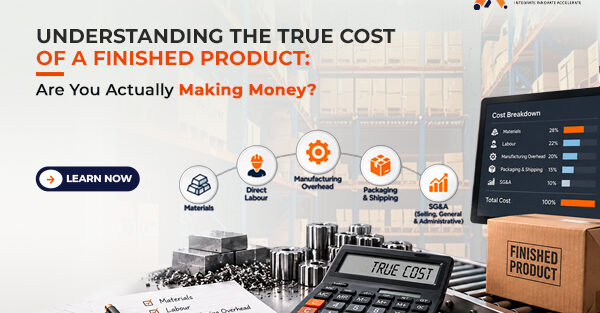
First, let’s consider what you already know. Direct materials represent the initial elements of which the final product consists of. Direct labour is the labour of your machinists or assemblers who assemble the part.
Nevertheless, even such obvious expenses can be overestimated or underestimated. Have you considered scrap and spoilage? Suppose you require 100 pounds of steel to manufacture your part, but you lose 5 pounds during each manufacturing cycle. Thus, not only do you use 100 pounds of material but also 105.
The Invisible Scapegoat: Manufacturing Overhead
Here comes the confusing part and where most manufacturers lose money. Manufacturing Overhead (MOH) comprises everything involved in keeping the plant operational but is not directly associated with the manufacture of any product.
These include indirect materials (coolant, lubricants, personal protective equipment), indirect labour (quality control, maintenance staff, floor supervision), as well as facility expenses (rental cost, property taxes, depreciation of machinery and utilities).
If you manufacture only one product, it might be fine to take the entire overhead and divide it by the number of products. However, if you produce several products, you must adopt some system, such as ABC, to distribute the overhead. A product that takes three hours of machine processing needs to pay for more of the factory rent than a product taking ten minutes of machine time. Otherwise, you will be overpricing the simpler products and under pricing the more complex ones.
The Forgotten Cost Factor: Non-Manufacturing Expenses
The harsh reality is that simply because an item has come off the end of the production line, it has not been “completed”. Only when it reaches the consumer and money changes hands does it become “completed”.
To understand how much something really costs, you need to consider non-manufacturing expenses. This includes packaging, freight, insurance, and warehousing. It also includes a portion of the selling, general, and administrative (SG&A) expense, such as the salary of your salespeople who sold the item, or the commissions you pay to distributors.
If it costs $50 in raw materials, labour, and overhead to manufacture a product, but an additional $15 to package, ship, and sell it, your actual cost is $65. If you price your product at $60 because you based your calculation only on manufacturing costs, you are losing $5 per unit shipped. And volume will only hasten your financial failure.
The Road to Being in the Black
Cost accounting is an ongoing process that necessitates having a feedback loop in place between your factory floor and your accounting system. The key is real-time data collection, where you have systems that record real labour costs, material usage, and machine downtimes, which feed directly into your accounting system.
Stop speculating and start counting. By spending some effort calculating the actual cost of your finished goods, including all materials, labour, overhead, and after production costs, you’ll have your own greatest advantage, pricing with certainty.