
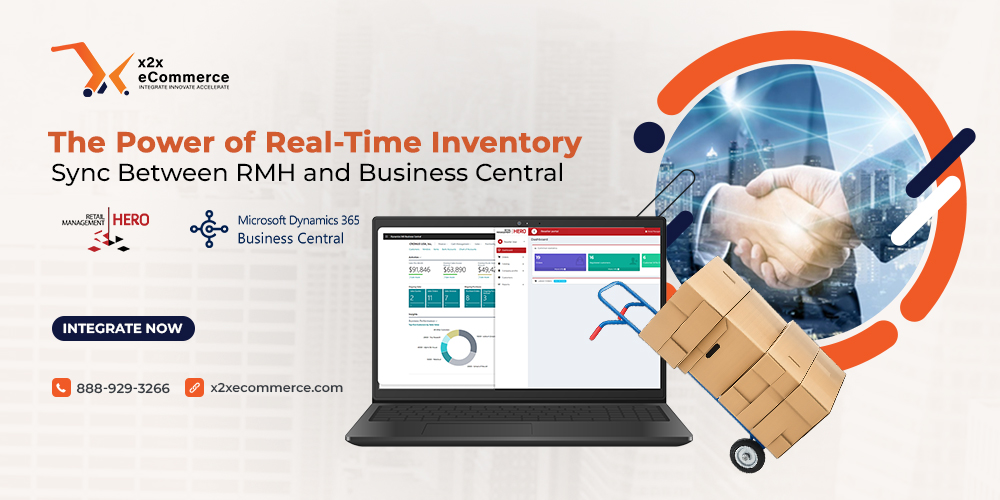
As a retailer that has integrated Retail Management Hero (RMH) into their point-of-sale systems and uses Microsoft Dynamics 365 Business Central on the back end, you’ve got yourself a solid software platform for running your business. RMH takes care of the technicalities of the POS and your stores, and Business Central takes care of accounting, your supply chain, and all the reporting aspects.
However, Do They Communicate with One Another?
For many developing companies, the interface between the storefront and back-office processes remains a black box. The use of batch synchronization where updates occur only once a day or even once an hour sounds like something out of the last century.
In modern omnichannel retail, Real-Time Inventory Sync cannot be considered a luxury; it is necessary. Here is why you need to integrate RMH and Business Central in real time.
The Issue with “Yesterday’s” Data
Consider this situation: A customer is browsing your website (or a salesperson is calling from Store B) looking to see if there is stock of a hot-selling product.
Business Central shows that you have 50 pieces of the product.
Unfortunately, 20 pieces of the product were sold by Store A (through RMH) an hour ago.
Since your system updates only via batch processing at midnight, your website will still show that you have 50 pieces in stock.
The consequences include overselling, cancelling orders, and losing out on sales opportunities.
What is Real-Time Sync?
With real-time sync, there will be an instant and simultaneous connection between RMH and Business Central. As soon as the transaction takes place on RMH, an alert is sent out to BC to make sure that the book is updated.
Sale at the POS:
Decrease inventory in BC.
Product Delivery at the Warehouse:
Push products to RMH and make them available for sale.
Return of a Product:
Instant stock changes on both platforms.
4 Key Advantages of Real-Time Integration
1. True Omnidirectional Implementation
If you need to enable “Buy Online, Pick Up In-Store” (BOPIS) or ship from store options, then you absolutely need real-time integration. It’s impossible to guarantee the availability of an item if your data syncing doesn’t occur in real-time. With real-time inventory, whatever the customer sees in front of them matches up with the physical inventory.
2. Over-selling Avoidance
There’s nothing worse for a company’s reputation than delivering “Out of Stock” notifications several days after the customer made the purchase. With real-time syncing, you won’t be selling things you don’t have in stock.
3. Better Buying Decisions
Data drives the prediction of demands and the creation of Purchase Orders (POs). Having outdated sales data in Business Central could mean that you make bad buying decisions. With real-time information, you can accurately predict future demands for your products.
4. Accurate Accounting
Every month, reconciling the books becomes a nightmare if the cost of goods sold does not agree with the sales account. Real-time synchronization ensures that COGS is automatically calculated every time there is a sale transaction.
The Process Explained: Middleware Integration
So, what is the answer to this question? RMH and Business Central don’t usually understand each other straight away. What you need is an intermediary (or middleware).
Instead of using a traditional file-based transfer (such as CSV or FTP), you use API-based connectivity for a faster integration process.
The Spark:
A cashier makes a sale on RMH.
The Action:
The integration middleware recognizes this event immediately.
The Transfer:
The middleware pushes the transaction information to Business Central through the API.
The Update:
Business Central processes the information and updates the Item Ledger Entry accordingly.
This takes milliseconds, allowing you to ensure that when your customers get their receipts, everything has been accounted for already.
Are You Ready for Real-Time Synchronization?
The shift from batch processing to real-time synchronization marks an advance in maturity. It necessitates a reliable internet connection at your retail locations and the appropriate integration partner who will manage the mapping logic.
But the benefits come instantly. You no longer incur losses due to faulty data, your employees’ time is not wasted verifying information manually, and you provide your customers with the experience they expect from you.
Do not allow your ERP system and POS solutions to be on separate timelines. Synchronize them in real-time to enjoy all the perks of doing business in the digital era.