

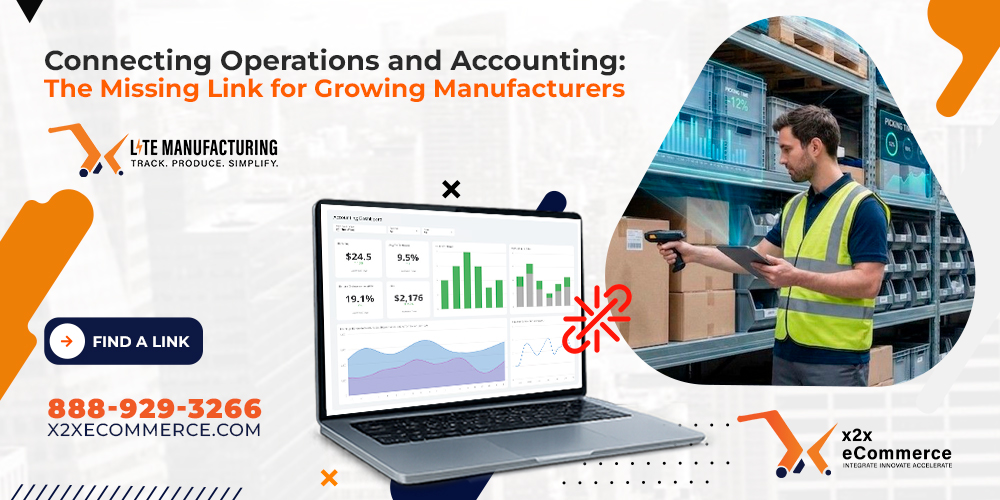
Within the lifecycle of the manufacturing company, there is one very important turning point which is often ignored by the business owner. It is the period when the business becomes so complicated that “gut feeling” approach can no longer be used. But still does not reach the level of complexity required for an ERP system worth millions of dollars. This stage represents the gap between Operations and Accounting functions which may be found in about 80% of all manufacturers.
The lack of coordination between production operations and accounting department is what prevents many growing businesses from making profits. This is the gap that x2x Light Manufacturing intends to close.
The Great Divide: Two Languages, One Company
The fundamental issue here is that Operations and Accounting do not speak the same language. On the production line, Operations uses numbers in terms of productivity, measured in cycle times, yield, and throughput. Back in the office, accounting uses money in terms of COGS, labour costs, and inventories.
A manufacturing company that operates on manual systems, a system of spreadsheets, paper-based timecards, and separate computer programs will end up with two entirely different languages never spoken together. This leads to a situation where data is passing using texts or telephone. A production employee fills out the time sheet, the manager transfers that data into a spreadsheet, and the accountant finally makes sense of its weeks later.
Reasons Why This Gap is Problematic
Not having a direct link between your accounting and operations means that you have no way of seeing what is happening in real time. For example, you may assume that your line of goods is highly profitable, considering the selling price, but there is a possibility that your operation margins are being eroded by high scrap levels or longer labour hours, which accounting isn’t aware of.
The gap also affects cash flow. Without knowing material consumption and future need. Since your warehouse has not done a manual update, you cannot see the true value of your assets. You will purchase based on false information.
Filling the Void Through x2x Light Manufacturing
The answer doesn’t lie in hiring more accountants or reducing production rates. The answer lies in automating the process of data exchange. It is in this capacity that x2x Light Manufacturing fills the gap.
In essence, x2x Light Manufacturing becomes the digital connection that bridges physical manufacturing activity and the corresponding accounting thereof. x2x design allows direct interaction with your financial management system to create a reaction for every physical event that takes place on the factory floor.
Labour Tracking in Real-Time: When a shop-floor employee clocks into a job through x2x, that is immediately categorized as “specific job cost,” as opposed to “vague payroll hours.” The accounting department sees labour costs come through in real-time and can finally say goodbye to that stressful month-end reconciliation process.
Inventory Consumption Automated: When work order consumes material, x2x automatically adjusts the inventory account. There is no guess for inventory anymore, because the system knows the exact finished products and consumption.
One Source of Truth: Because the connection exists, both the Operations Manager and the CFO review the same data source. So, when the owner says, “Are we making money on Job X,” the answer comes right away.
End the Guesswork, Make Connections
There’s no way to expand your manufacturing company when your financial information is constantly living in the past. For growth, you require the factory floor to be in sync with the Operations and Accounting office.
x2x Light Manufacturing is the missing piece. It makes sense of the complicated truth of manufacturing by providing clear and useful financial information. It removes the barriers between doing the work and reporting on the work, so you can concentrate on what truly counts expanding your business.