

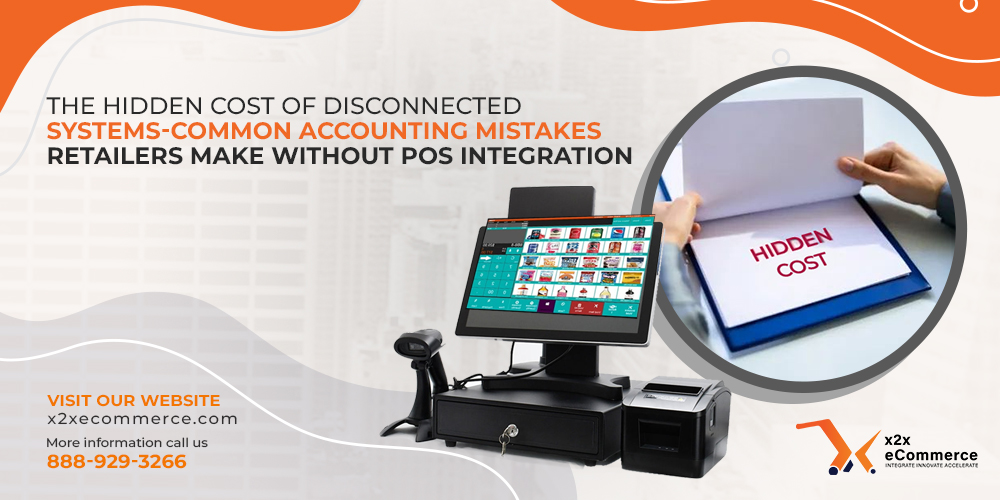
If you’re a retail store owner, you understand the feeling. It’s the end of the day. You’ve balanced the cash register, locked the till, and now you’re looking at a stack of receipts or a CSV file from your point-of-sale system. Your next task? Manually entering every single one of those sales into your accounting software. It’s a tedious and soul-crushing task that most retail store owners dread. But while the task is certainly tedious, running a retail store without integrating your point-of-sale system with your accounting software is a recipe for disaster.
When your sales floor doesn’t “talk” to your back office, you’re not just wasting time, your retail store is creating a breeding ground for expensive accounting errors.
Here are the most common accounting errors that retailers make without POS system integration and how they might be costing your retail store money.
1. The Human Error Factor
The first and most obvious mistake is also the most critical and dangerous mistake you can make. The human error factor is the most common mistake that occurs when you physically enter your POS data into your books.
The Mistake: Entering $5,200.00 in sales as $520.00 or forgetting to enter a batch of credit card transactions entirely.
The Consequence: Your Profit & Loss statement will be wrong. You might think you’ve had a terrible month when you’ve had a great month (or vice versa). This can cause you to make poor decisions and cause cash flow problems because you’re not aware of your true financial situation.
2. Inventory Valuation Nightmares
For retailers, inventory is cash sitting on a shelf. For inventory accounting to be accurate, it is essential to integrate it with your accounting system. It is almost impossible to track your Cost of Goods Sold (COGS) in real-time without it.
The Mistake: Using periodic manual counting methods to keep your accounting records up to date. You sell a product in your store, and your accounting system still reflects the same amount of inventory until you manually make the change.
The Consequence: Your Balance Sheet will never reflect accurate numbers. You will end up paying too many taxes because your records will reflect more inventory (an asset) than you have. In addition, you will never know what inventory is dead stock until it is too late to sell it off.
3. The Sales Tax Trap
Sales tax compliance is becoming increasingly complex, with different rates for different cities, counties, and even products.
The Mistake: Manually calculating sales tax and assuming the same sales tax rate for all sales. Without a direct flow from the POS system to the accounting system, the complexity of tax-exempt customers and tax holidays will be missed.
The Consequence: If sales tax is under collected, the company is legally required to pay the difference out of its own pocket. If sales tax is over collected, the company is annoying its customers and creates a nightmare in terms of liability. Manual reconciliation creates the risk of an audit finding discrepancies in sales tax collected and sales tax reported.
4. Reconciliation Headaches
Ask any accountant what his or her least favourite task is, and the answer will undoubtedly be “bank reconciliation.” It’s painful enough when the systems are integrated; when they are not, it’s agonizing.
The Mistake: Attempting to match lump-sum bank deposits with individual sales entries that were entered days or weeks prior.
The Consequence: “Uncleared items” start building up in your accounting software. You are no longer aware of which transactions have been deposited into your bank. It is very hard to catch any fraudulent charges, bank errors, or employee withdrawals.
5. Misclassified Expenses and COGS
A POS system can beautifully manage the income side of the equation. However, the expense side can become a mess if the systems are not connected.
The Mistake: Manually tracking supplier invoices and inventory purchases without the level of detail that the POS system can provide. This means that “supply costs” can be broadly categorized rather than being accurately attributed to the specific product they belong to.
The Consequence: You will not be able to accurately determine your true margin on a product. You may believe that you have a 50% margin on one of your best-selling products. However, if the expense side was not accurately factored in because of manual tracking issues, the true margin may be only 20%.
6. Lagging Financial Data
In the fast-paced world of retail, decisions need to be made in an instant.
The Mistake: Waiting until the end of the month to update the books because the entry process is so time-consuming.
The Consequence: You are driving your business looking in the rear-view mirror. It’s not until the end of the three weeks that you’ve realized the specific product line is losing money.
The Solution: Connect Your Systems
The solution to these mistakes is automation. By automating your business through integration with your accounting software, you can streamline your business processes. When a sale is rung up at the register:
- Revenue is recorded.
- Inventory is tracked.
- Sales tax is accurately recorded.
- The transaction is ready for reconciliation.
Stop using your accounting software as a digital notebook! As retail store owners your accounting software should be a powerful tool driving your business forward.